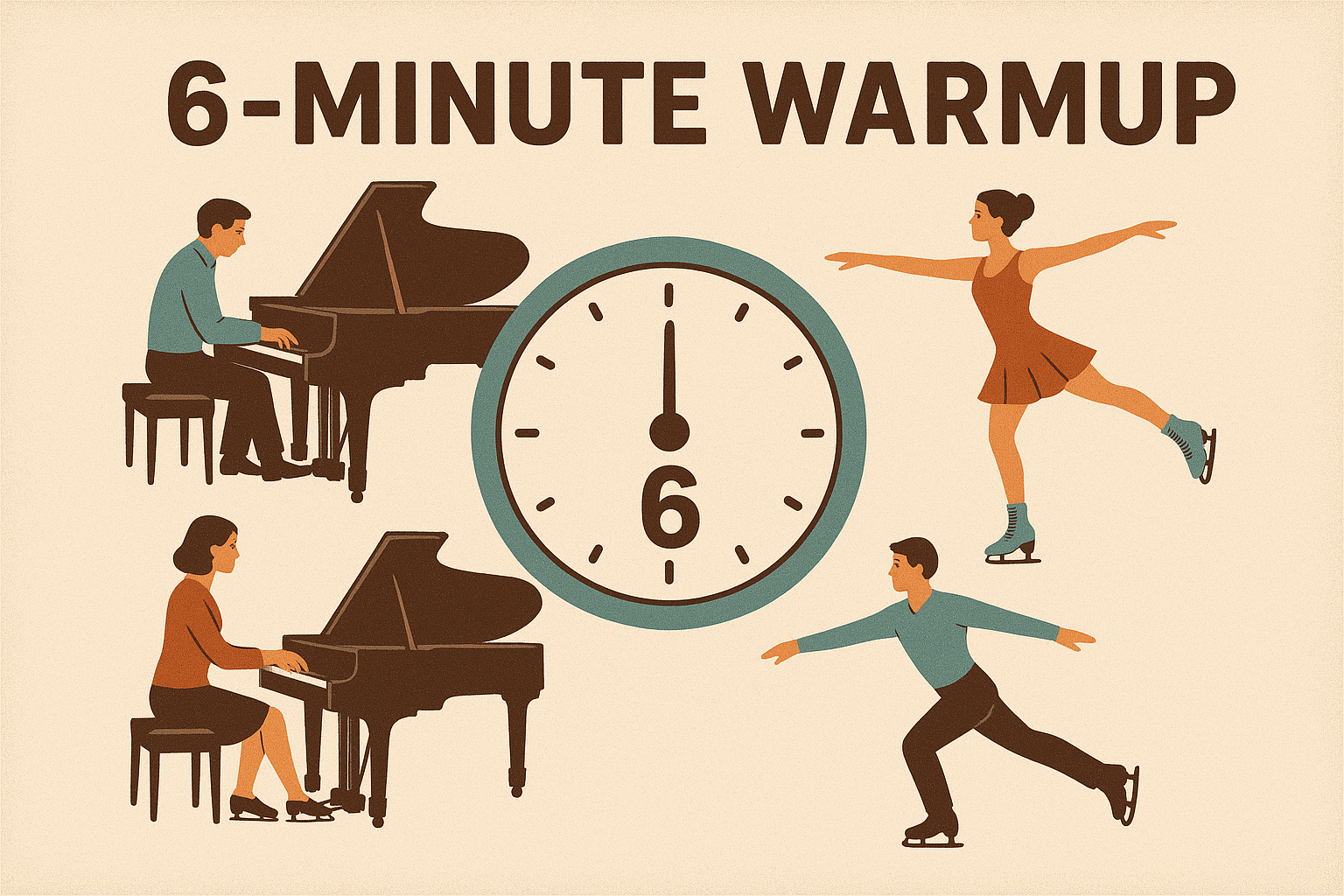
I was amused at the curious coincidence that I would be getting a 6-minute warmup, not for figure skating, but for piano instead.
To my figure skating friends and those who follow the sport, the 6-minute warmup is a familiar fixture at skating competitions. Competitors are allotted 6 minutes to warm up on ice at the start of their event group. As the timer ticks down during these precious 6 minutes, competitors take the ice, working up from fundamental skills to warming up their money jumps and other elements in their program they are due to perform. It’s a chance for them to feel the ice, get their muscles working, and prepare themselves physically and psychologically for their big performance ahead.
So, when during the BPAA Piano Festival a few weeks ago, a warmup piano was arranged for performers to use before their turn (a luxury not afforded at our regular Soiree recitals), I was amused at the curious coincidence that I would be getting a 6-minute warmup, not for figure skating, but for piano instead.
This gave me the idea: why don’t I plan my 6-minute warmup routine for the Festival, just like how I did as a competitive skater? This would be a great exercise for me to figure out how prepared I can be with just 6 minutes of warmup, especially since I was due to perform a piece of substantial difficulty, the last movement of the Chopin B minor Sonata, at the end of a long tiring day without any time to practice.
It’s strange that for all my years of piano playing, I had never given much thought to how best to warm up for a performance. It was only when I began figure skating competitively that my coach had me plan my warmup routine down the minute—a common practice amongst competitors, in fact. We identified moves and exercises that would get me ready in that short amount of time: starting off with deep stroking and skating skills for about a minute or two, then moving on to preparatory exercises for my jumps. I would mentally review the important focus items (“imagine you’re moving down the train tracks and look over the fence as you jump”). By minute four or five, I would round out the warm up with a few spins or some choreography to get into the character of my program. I practiced this routine during training and in exhibitions, refining the order and selection of warmup exercises each time.
Back in piano land, I adopted the same principles for planning the 6-minute warmup. What physical and mental states do I need to be in to feel ready to perform? What are the attentional focuses for my piece and goals for the performance? Observing how long I usually take to warm up my fine finger motions, activate my full body engagement, and wake up my musical brain: some 30 minutes of gradual work up. It would be quite a task to compress that into 6 minutes! All the more why a warmup plan is essential.
Why don’t I plan my 6-minute warmup routine for the Piano Festival, just like how I did as a competitive skater?
Devising a Warmup Plan
The toughest part for me was getting my cold fingers warmed up for the fast and winding leggiero passages in the second theme. I decided to start the warmup with basic scales in all 24 major and minor keys, ordered by the circle of fifths instead of chromatically, because several passages in the piece move harmonically by fifths; played at the extreme registers to simulate the left and right leaning that the piece involves; and deliberately using the same leggiero touch. I also like the meditative focus of playing scales—basic and familiar, yet satisfying and calming—just what I need to quiet a racing mind. Timing: just around 2 minutes.
After extensive scales, I didn’t want to jump straight into the leggiero passages right away, so next on the plan is to play through some of the chordal passages to get my large muscle groups working—my core, back and shoulders. This will also double up as a chance to reiterate some recent changes I had made in phrasing, pedaling and tempo that still needed my conscious attention.
Now it’s time for the leggiero passages. Too long to fit into the limited time, I selected a handful of short segments (including my least favorite portions) that I will play with the “soldier march”1 practice method, exactly how I would practice it at home. The goal here is to, in short order, make it feel as comfortable as it does at home.
I would be about 4 minutes in by now, and should be ready to pull off the passage at speed. Almost at speed, anyway, with my metronome set slightly under-tempo at 94 bpm, a tad slower than the low to mid 100’s at which I usually perform this piece. It’s fast enough to be musically viable but slow enough for my brain to comfortably stay ahead of the music. If that’s the way to boost my sense of control ahead of a looming performance, then that’s how I would play my mental game.
The last item on the agenda will be the opening 4-bar introduction, straightforward dotted quarter chords, to be played also at 94 bpm but without the metronome. On stage, that will be how I will tell myself to start, but whether by habit, nerves or adrenaline, I will undoubtedly up the speed, which will then end up at the desired tempo—perfect!
I dedicated several days where I would start my practice with the warmup routine and follow it with a run-through. A few adjustments were needed here and there. How warmed up was I after 6 minutes? More time would have been better, of course, but I started to feel more comfortable with the warmup + run-through arrangement simply from having practiced it.
The takeaway from this exercise is that careful planning is essential to make best use of the limited time available (including instances when we don’t even get any warmup at all2!) The last thing you want to happen is to warm up aimlessly, spend time on things that don’t actually help your upcoming performance, or end up more anxious when it goes poorly—and this is true even if you had all the time in the world to warm up. With a solid plan, one that sets you up for success, you can trust that you are as ready as possible for the big performance.
Footnotes
- Whereas various teachers have taught me to “do staccatos” or “pulse each note”, I have found that what works better for me is to exaggerate my finger motions as if they were doing a high march like a soldier. ↩︎
- I hadn’t mentioned “off-piano” warmup. This is important to incorporate before the on-piano warmup, and even more so for when there is no warmup time at all. Off-piano warmup can include physical warmup as well as mental practicing, and should be planned as well. ↩︎


Leave a Reply to Chia Ying Lee Cancel reply