How I used movement to address a stubborn rhythmic challenge in Chopin.
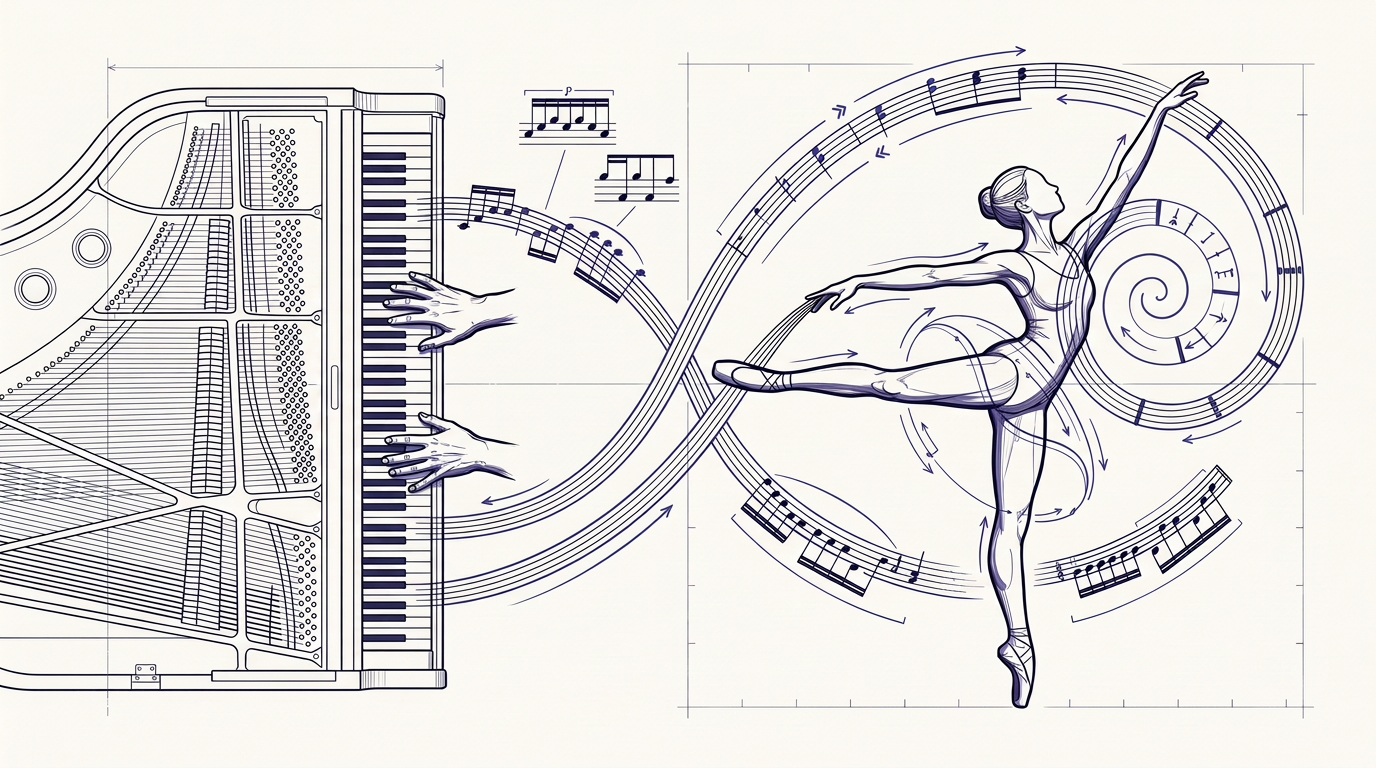
Musical rhythm is too frequently taught abstractly as a timekeeping task, as if time were an independent axis in a musical x-y plane, orthogonal to other musical elements of pitch and expression. But as listeners, we do not hear music as a decomposition of elements; we hear it as a synthesis of musical statements and gestures—shaped by rhythmic patterns, pitch contours and harmonic structures—that propel us to move and dance along.
At the surface, agogic inflection and rhythmic precision seem at odds with each other: employing rubato to escape metronomic rigidity may risk diluting our underlying sense of pulse. What, then, makes rhythmic flexibility still rhythmically recognizable?
Pulse and rhythm perception go beyond temporal objectivity. Rhythm exists within a broader musical context, inseparable from other elements of pitch, dynamics and agogics, which all contribute to how we perceive and understand it. The brain infers meter from regular patterns of stresses—both agogic and dynamic—and note groupings, from which we perceive downbeats and measures. Even when the tempo fluctuates, predictive timing mechanisms in the brain quickly adjust to these agogic inflections, latching on to cues from accents, dynamic shaping, harmonic movement and timbral color, to maintain a coherent sense of pulse and rhythm1. In fact, rhythm perception is not confined to music; it is integral to how we understand speech, regulate our walking cadence, and coordinate the timing of our everyday movements.
The question of rhythmic flexibility had been on my mind for a long time, including as recently as last week, when I was working (yet again) on “fixing” the march-like dotted rhythm in the 3rd mvt of Chopin’s B minor Sonata. This rhythm occurs repeatedly throughout the first theme, and I was having difficulty keeping it consistent—at least, according to critique I had received multiple times. I assumed they meant that I needed to count better: Ta-a-tik-a ta! Ta-a-tik-a ta! But the rhythm still felt awkward: not only was I preoccupied with pressing keys at the correct millisecond, it distracted me from the inflections I wanted to incorporate.
At a lesson with an excellent faculty member at the Oberlin Amateur Piano Festival the day before, as I struggled to stabilize my counting, I noticed out of the corner of my eye that she was swaying to my pulse. That rekindled an age-old idea: it’s less about counting, but rather about feeling the pulse through movement.
The connection between movement and rhythm is well known. Some music pedagogy schools purposefully develop this connection: a core branch of the Dalcroze method is eurhythmics, which encourages students to experience music through natural whole-body movements such as walking, stepping and clapping. Neuroscience has shown why this works: auditory and motor regions of the brain are tightly coupled, with bidirectional connections—neural pathways such as the arcuate fasciculus—that support predictive timing and synchronization between movement and sound2. Why don’t we leverage this connection more deeply when playing music?
After discussing a proposed gestural idea for the dotted rhythm (a pattern of expressive stresses with the 1/16th note flowing into the downbeat, ba-dum), I went back to the practice room and experimented with associating it to a physical movement gesture. I exaggerated the swaying. I stood up and improvised a basic dance movement, reminiscent of a slow march, to emulate the combination of the rhythmic pulse and the expressive gesture. I distilled that into a more discrete motion while sitting at the piano, whilst continuing to imagine my improvised dance.
What I immediately found was that thinking of this rhythm as a musical gesture represented by a physical movement helped unify its execution. By imagining the movement, the rhythm became more natural and consistent. Further, connecting the rhythm to a physical gesture provided a foundation upon which to inject agogic flexibility without distorting the basic gesture. This helped me avoid the pitfall of detaching the abstract rhythm from other musical elements—agogic emphases, dynamic shape and pitch contours—that in combination is what makes it recognizable as a rhythmic gesture.
Why was this approach effective? Thinking through the motor learning literature, I drew several conclusions. It utilized elements of imagery and cognitive chunking. Chunking consolidates the complex combination of micro-timing actions and expressive inflections into a single gesture, thereby reducing cognitive load. Using imagery shifted my focus away from abstract counting (an internal focus of attention) towards the desired gestural effect; research has shown external or goal-oriented focuses to be more effective than internal ones3. Crucially, connecting rhythm to physical movement exploits the auditory-motor coupling: audiation guides motor execution, while physical movements enrich the musical imagination.
Humans are naturally drawn to music and movement. Movement is an integral part of music making. When detached from an innate sense of movement, it becomes purely academic—intriguing in its own right, but only part of the full picture when it comes to realizing the music. Next time you encounter difficulty with a rhythm, try standing up from the piano to find a natural movement to match the musical gesture. Music can be much more meaningful when grounded in movement, and we lose something essential if we dismiss that connection.
Footnotes
- See, e.g., [Lar2009, Noz2012, Wol2020] ↩︎
- The arcuate fasciculus plays an important role in speech learning and also has implications for singing and music making. [Hal2011] ↩︎
- The notion of cognitive chunks has been posited since the mid-1900’s, beginning with the seminal paper of [Mil1956]. The study of attentional focuses crystalized over the more recent 2 decades, and is summarized in this review paper [Wul2013] ↩︎
References
- [Lar2009] Large EW, Snyder JS. Pulse and meter as neural resonance. Ann N Y Acad Sci. 2009 Jul;1169:46-57.
- [Noz2012] Nozaradan S, Peretz I, Mouraux A. Selective neuronal entrainment to the beat and meter embedded in a musical rhythm. J Neurosci. 2012 Dec 5;32(49):17572-81.
- [Wol2020] Wollman I, Arias P, Aucouturier JJ, Morillon B. Neural entrainment to music is sensitive to melodic spectral complexity. J Neurophysiol. 2020 Mar 1;123(3):1063-1071.
- [Hal2011] Halwani GF, Loui P, Rüber T, Schlaug G. Effects of practice and experience on the arcuate fasciculus: comparing singers, instrumentalists, and non-musicians. Front Psychol. 2011 Jul 7;2:156.
- [Mil1956] Miller, G. A. (1956). The magical number seven, plus or minus two: Some limits on our capacity for processing information. Psychological Review, 63(2), 81–97.
- [Wul2013] Wulf, G. (2013). Attentional focus and motor learning: a review of 15 years. International Review of Sport and Exercise Psychology, 6(1), 77–104.


Leave a Reply